Wednesday, February 22, 2012

Ash Wednesday: Invitation to Abide


For Lent this year, I am committing to a practice of abiding, of spending intentional time resting with and listening to the Lord. I will be using Macrina Wiederkehr’s wonderful new book, Abide: Keeping Vigil with the Word of God, as my guide.

I will not necessarily be sharing reflections of my time on a daily basis, as I do not want the activity of posting to become my focus. However, the times spent prayerful listening will undoubtedly spill over onto the blog. What I do want to be sure to share are some notes from the book’s introduction, to give you a taste of the meditations included therein.

Sister Macrina lays out the following path of lectio divina (sacred reading as prayer):

~ Wait in silence

~ Read contemplatively

~ Listen obediently

~ Pray as the Holy Spirit leads

~ Abide

Of this final step, we are told:

This is a beautiful moment spent in pure contemplative presence with the Beloved. This is love. “Remain in me, as I remain in you” (John 15:4). “Be still and know that I am God” (Ps 46:10, NRSV). Dwell. Remain in love. ABIDE.

We are invited to see this process as a pilgrimage of sorts, with each pause for reflection as a holy space.

Finally, we are invited to carry our vigil with us as we move about our day:

Be open to God’s Word blossoming everywhere. Walk with awareness through forests, parks, and gardens, along the seashore, or down a busy city street. The Word of God is near you. Climb a mountain and the Word will meet you. Move mindfully through your daily work tasks – the Word is at your fingertips. Celebrate the Eucharist with a community of struggling believers. You will be enfolded into God’s Creative Word.

I am looking forward to leaning into the 40 reflections and prayers in this little book as we move slowly, steadily from the solemnity of Ash Wednesday to the celebration of Easter.

Tuesday, February 21, 2012

Preparing for Lent - 3 of 3


Finally, we come to the “Be” of “Be Here Now” – our orientation toward our creator, the invitation to abide, to be still, to cease striving, the practice of resting and listening.

Pause.

Breathe in slowly.

Breathe out slowly.

Let’s continue…

In John 15, we are not only invited to abide in Christ, we are informed that in order for the fruit of the spirit to grow from our lives, we must abide in Christ. The fruit of love, joy, peace, patience, kindness, goodness, faithfulness, gentleness and self-control is germinated when our lives are rooted in God, when we slow down, allow ourselves to be still, and remember that there is a story bigger than ourselves and a power greater than our own.

When we find a rhythm of Sabbath in our lives, when we identify pockets of time (whether it be a quiet coffee break, a day set apart, or a sabbatical year) in which to release control to God and open our hearts to hear the spirit’s stirrings, we are reminded of who we are. We are a beloved creation, with unique gifts to share. We are also a limited creation, and we are not expected to do it all.

The poet Rilke writes,


I am, you anxious one.
Don’t you sense me, ready to break into being at your touch?
My murmurings surround you like shadowy wings.
Can’t you see me standing before you cloaked in stillness?
Hasn’t my longing ripened in you from the beginning as fruit ripens on a branch?

In Psalm 46, God speaks into the midst of chaos with the words: Be still and know that I am God. In a few retreats I have attended, this verse is used to draw us into a time of rest and quiet.

Be still and know that I am God.

Be still and know that I AM.

Be still and know.

Be still.

Be.


Our prayer exercise for the practice of being was an invitation to centering prayer. Taking your word from the lectio divina in the “Here” post, try sitting quietly in the presence of God, with nothing to share, nothing to ask, nothing to expect. If you find your mind starting to wander, simply repeat your word – silently, slowly, calmly – to draw you back to the moment. Rest in God’s presence. Be present. Abide.

Monday, February 20, 2012

Preparing for Lent - 2 of 3

In the previous post, we looked at the “Now” of “Be Here Now”- our orientation to time and our choice to practice forgiveness & trust over bitterness & anxiousness. Continuing our reverse trek, we will now look at the idea of being present “Here”.

Here is an orientation to place, to the space we currently inhabit, the community we are currently planted in, the circumstances that currently surround us. I associate it with terms such as stability, rootedness and connection.

When we think of Jeremiah 29, we most often think of verse 11 – God knows the plans he has for us, and they are big ones! The future’s so bright, we gotta wear shades! Let’s go get ’em! It’s all fine and dandy that our creator has plans to prosper his people, to give them hope and a future, but that doesn’t change the fact that from Adam to Abraham and beyond, God’s people have always had to endure the nitty-gritty of daily life, and the consequences of their choices. That’s why my favorite part of Jeremiah 29 is found earlier in the chapter, in verses 4-7:

This is what the LORD Almighty, the God of Israel, says to all those I carried into exile from Jerusalem to Babylon: “Build houses and settle down; plant gardens and eat what they produce. Marry and have sons and daughters; find wives for your sons and give your daughters in marriage, so that they too may have sons and daughters. Increase in number there; do not decrease. Also, seek the peace and prosperity of the city to which I have carried you into exile. Pray to the LORD for it, because if it prospers, you too will prosper.”

Once again, the Israelites have found themselves in a foreign land, not a place they want to be, not the place God wanted them to be, yet here they were. And rather than a baby in a basket, rather than plagues and a Passover, God tells them to settle down, to make a home, to plant themselves in this place. And that prosperity? It will be dependent on how much they participate in seeking peace and prosperity for this land of their exile.

In the movie Click, the main character finds himself at the end of his life, distraught because while he was trying to fast forward through the moments he found dull or difficult, he missed out on the moments that were sacred and beautiful. In much the same way, if we keep waiting for life to happen somewhere else, under different circumstances, WE MISS LIFE! Participating in life means we are willing to be vulnerable, allowing ourselves to be known beyond our masks. Participating in life means we take the chance of being hurt, and we take the chance of being loved. Participating in life means releasing our illusion of control and embracing it all – the boredom and the grief and the beauty and the joy and the bellyaching laughter.

Being rooted in a place, does not mean that we can never go elsewhere, but it does mean we do so intentionally. When we read about the Holy Spirit going with us in Jerusalem, and in all Judea and Samaria, and to the uttermost parts of the earth – some of us become very eager to jump to all of those uttermost parts. However, unless you choose one of those places, root yourself into community there, allow your walls to come down so that you can truly engage the people around you, you are not doing much for the peace and prosperity of that place, or the peace and prosperity of your own heart.

Mother Theresa famously said, “I want you to go and find the poor in your homes. Above all, your love has to start there. I want you to be concerned about your next door neighbor. Do you know who your neighbor is?” It can be very easy to go and serve in unfamiliar places where we only land for a short while, because it does not require much vulnerability on our parts. But if we really want to impact and be impacted by a community, we have to be fully present there, allow our walls and masks to fall to the ground, and settle down into daily life with one another.

The prayer exercise we practiced in conjunction with the discussion of being “here” was a lectio divina reading of Psalm 37:1-9. Sit with the passage and ask the Lord to speak to you about what it looks like to settle down into a place. Read slowly through the passage and get an overview of the verses. Pause, and let it sink in. Read slowly through it another time, and pay attention for a word that stands out to you. Read slowly through it a third time, and listen for your word in context. Sit with that word for a time, and allow the Lord to plant it in your heart.

Sunday, February 19, 2012

Preparing for Lent - 1 of 3


Several weeks ago I had the privilege of talking about the importance of being present in the reality of our lives. Last week I read the introduction to Macrina Wiederkehr's Abide: Keeping Vigil with the Word of God, and realized the 40 reflections would make a wonderful Lenten practice. So, I thought I would rehash some of my notes on presence in the days leading up to Lent, and give a brief introduction to Sister Macrina's book on Ash Wednesday. I hope these reflections will benefit your journey, as well. The practice of presence, of abiding, is not one I have down, but rather one I have committed to developing this year.

When thinking about the importance of presence, of dwelling with God in the reality of my life, I can't help but settle on the phrase "Be Here Now". And, while I know that the beginning is a very good place to start, I chose to begin at the end: NOW.

Now is an orientation to time, to the present, wedged between what has been and what will be. Now is a place where we choose to experience life as it presents itself. When we choose to live stuck in the past, we choose to live in bitterness over things we miss, things that hurt us, things we never accomplished - we have the illusion that by holding on to these things we some how have control over them or can change what happened. Similarly, when we choose to live focused on the future, we choose to live in anxiousness over what may or may not happen - we have the illusion that by staying focused on the maybe-but-not-yet that we can control those things before they ever come to be.

Matthew 6:25-34 has been one of my favorite passages since youth group days - long before I truly understood the significance: do not worry... can anyone by worrying add an hour to their life... do not worry about tomorrow, tomorrow will worry about itself... each day has enough trouble of its own.

Each day has enough trouble of its own.

Exodus records the story of the Israelite journey from slavery in Egypt to the promised land, a journey that was much longer than it had to be. The Lord was present with Israel, freeing them from Egypt, making a way through the sea, guiding them through the desert with a cloud by day and a pillar of fire by night, yet despite God's presence and provision, it still took the Israelites 40 years of wandering around the wilderness before they reached their not-so-distant destination. Why? Bitterness and anxiousness.

The Lord promised to provide bread and meat daily for the people as they progressed on their journey: The people are to go out each day and gather enough for that day. Yet the Israelites were bitter, fondly remembering the food they ate in captivity, lamenting the simplicity and perhaps strangeness of the food that was being provided for them daily. They were also anxious, concerned about if there truly would be enough food the next day, what the new land would really be like, what it would truly take to inhabit.

Each day has enough provision of its own.

Elijah had a bitterness/anxiousness episode of his own in the wilderness. After being miraculously provided with food by a poor widow, after having a part in bringing that woman's son back to life, after an amazing experience displaying the presence of God before the prophets of Baal on Mt. Carmel, Elijah found out Jezebel was angry and wanted him dead, so he fled. God was continuously present and doing miracles all around him, but one angry woman and the prophet was spent. Exhausted and afraid, the weary prophet finds himself in the wilderness, with God once again providing him with food & drink. God was present with Elijah as a still, small voice. Twice the Lord asked, "What are you doing here Elijah?" Twice Elijah lamented,
“I have been very zealous for the LORD God Almighty. The Israelites have rejected your covenant, torn down your altars, and put your prophets to death with the sword. I am the only one left, and now they are trying to kill me too.” Elijah was bitter. Bitter that he had done everything right, and yet his life was being threatened. Elijah was also anxious about what may happen should Jezebel get her way - despite how God had provided for him all along his journey.


Choosing to live in the present is a practice of choosing forgiveness & trust over bitterness & anxiousness. It is a practice of choosing to live in the only moment we truly have any control over, the here-and-now, and the control we have is that of being willing to forgive what has happened and being willing to trust God in what will come.


A prayer exercise that is helpful to keeping your spirit in the now is a daily prayer of examen. A time where you intentionally reflect on your day, offering thanksgiving and repentance where necessary, releasing bitterness and anxiousness where you find it, and preparing yourself to be fully present with Christ in the day ahead - to allow both its trouble and its provision to be enough.

Wednesday, December 21, 2011

Advent Practice: Sobriety

I don’t want to be the girl who has to fill the silence;
The quiet scares me, ‘cause it screams the truth.
~ Pink, Sober


Simplicity and sobriety are hand-in-glove.

I, being a lover of fun and silliness, am using a less stale & serious definition of sober, choosing the following qualities: practicing moderation or self-restraint; refraining from excess or overindulgence; calm, quiet, composed; rational, realistic; free from exaggeration or speculation.

When you practice sobriety, it’s not that you never indulge, but rather that you exercise restraint – knowing your limits and the effects on others.

When you practice sobriety, it’s not that you are never boisterous, but you also do not fear silence and solitude, recognizing that quiet moments can feed the soul.

When you practice sobriety, it’s not that you never contemplate the what-ifs in life, but you don’t allow those prospects to anxiously control your present experience.

We all have our strengths, our preferences, but just as introverts need community, extroverts need solitude. It may take a bit more effort if it is not the environment that energizes you, but it is necessary to keep your spirit in balance.

Sobriety is recognizing when you are isolating and need to get around people, to practice community.

Sobriety is also recognizing when you are spending too much time in the company of others because you don’t want to have to sit with your thoughts – to listen to yourself, to listen to God.

Sobriety is recognizing when you are dragging your feet and it is time to act, to take a chance.

Sobriety is also recognizing when you are rushing around doing everything you can to keep from being still and abiding in the Spirit.

Sobriety is living in reality – reality of your situation, reality of your resources, reality of your life.

When we practice sobriety, we are freed to practice simplicity because we are not trying to bury reality under piles of material, emotional and spiritual stuff.

When we practice simplicity, we are freed to practice sobriety because we are throwing aside those things that keep us from seeing the path we’re on as it actually exists.

It’s a chicken-and-egg scenario, really.

So, as we inch closer toward the celebration of Christmas, as the winter solstice ushers us into the path that leans day by day toward light, in the waning twilight of Advent, may we take an honest look at our lives, a deep breath, and a heartfelt prayer, and may we step forward in the joy that each day is enough.

Monday, December 19, 2011

Advent Practice: Simplicity

Originally shared December 18th as part of Eikon Church’s Advent service:

A few weeks ago, I was snuggled up on the couch with my Mom watching a Hallmark Christmas movie starring Kristie Swanson, the ORIGINAL Buffy the Vampire Slayer. Swanson portrayed a single mother at the end of her rope, doing the best she could to provide for her children and keep some joy in the midst of their less-than-meager holiday season. Early in the movie she was in a rush to get to her job and get the children ready for their babysitter when one of the kids asked for something to eat – I can’t remember, maybe a pizza or something delectable. What I do remember is Swanson reaching into the cabinet, pulling something out, and exclaiming joyfully & wide-eyed: “We’ve got ramen!”

My mom and I lost it with laughter, tears rolling out of our eyes, breathless from the humor of it all. My stepdad stared at us in justified confusion. The children in the movie were not impressed. They groaned. Seriously? Ramen? Could life get any worse?

My mom and I laughed because we knew there was truly life after ramen. That there was even, hard as it was to be believed, life WITH ramen. Even ramen back when it was 12 for a dollar. Even ramen when it had to be split three ways because pay day was still a day away. Even ramen when the DOG didn’t want to eat ramen anymore.

Now, the reason I was watching this movie with my parents is that I am back living at home, diligently paying down my debts. Somewhere between ramen, student loans and financial independence, I lost track of what it looks like to live within my means.

Not that I was living extravagantly, mind you, but a month would get tight and I’d put some necessities on my credit card. Clothes wear out, and a modest shopping spree would go on my credit card. A well deserved vacation to visit a friend who lived far away? You guessed it, on my credit card. An unexpected vehicle expense, an unexpected move, an unexpected fill-in-the-blank… on the credit card.

As I was living in community, I didn’t quite notice how much I had become a slave to the credit cards and their debt interest until I was faced with the need to live on my own again, and I realized, while possible, it would not be very practical. So, here in my 30’s, I returned home to free myself from debt’s chains and learn once again what living in simplicity looks like.

Excerpt from Richard Foster’s Freedom of Simplicity:

Contemporary culture is plagued by the passion to possess. The unreasoned boast abounds that the good life is found in accumulation, that “more is better.” Indeed, we often accept this notion without question, with the result that the lust for affluence in contemporary society has become psychotic: it has completely lost touch with reality. Furthermore, the pace of the modern world accentuates our sense of being fractured and fragmented. We feel strained, hurried, breathless. The complexity of rushing to achieve and accumulate more and more frequently threatens to overwhelm us; it seems there is no escape from the rat race.

Christian simplicity frees us from this modern mania. It brings sanity to our compulsive extravagance, and peace to our frantic spirit. It liberates us from what William Penn called “cumber.” It allows us to see material things for what they are – goods to enhance life, not to oppress life. People once again become more important than possessions. Simplicity enables us to live lives of integrity in the face of the terrible realities of our global village.

----------

If simplicity were merely a matter of externals, things would be quite easy. We would then need only to formulate the system (no small trick to be sure) that defines the boundaries – Christian faithfulness would allow us to live in this income bracket but not that one, to purchase this house but not that one. We would have a clearly definable arrangement, even if it would need periodic adjustment to keep abreast of inflation. It would be clear who is in and who is out, who is faithful and who is not. Presto, a new pharisaism. Very fine, thank you.

Sometimes I genuinely wish it were that way. And I have no desire to speak disparagingly of the many groups who have developed such systems. In fact, I envy them at times, because the clarity of that approach has immense power to motivate and change behavior. But as we all know, its end result is bondage and death. The letter always kills; the Spirit alone gives life. Gospel simplicity gives freedom and liberation.

The outer expression of simplicity must flow from the inner resources. It is learning to walk in the Spirit that builds the life of purity, unity, and grace. There is an inwardness that is central to our task; without it all is lost. We delude ourselves, however if we think we can possess the inner reality of simplicity without its having a profound effect upon the way we live…

Life is a journey, and we are often not at the wheel of control.

Mary certainly did not anticipate the sudden changes that came into her life, and the journey that laid ahead.

The more stuff we have cluttering up our lives, the less ready we are to keep moving along the journey – especially when change and chaos and transition come on the scene.

Old blog post from Dave Bruno, 3 Consumer Justifications That End in Crap:

There are at least three excuses those of us with too much stuff use to justify our excess.

It would be wasteful to get rid of it. Uh, no. It was wasteful to get it in the first place. Now it’s just plain stupid to allow it to keep cluttering up your life. What’s wasteful is the mental and physical space that the stuff you don’t need and don’t even want is taking up. Stop wasting your life. Get rid of the crap.

I might need it someday. The moment this justification passes your lips you know it’s not true. Seriously. Here, try this experiment. Go into your garage, find that box you haven’t opened in a decade, dig inside of it, and pull out that graphing calculator. Now go stand in front of a mirror and, speaking out loud, convince yourself that you might need it someday. Liar, liar, pants on fire. Get rid of the crap.

It has sentimental value. Then why did you bury it in the closet? Besides, you don’t even like the uncle who gave it to you. The nostalgia you’re really missing out on are all the good times you could be having if you weren’t constantly reshuffling stuff inside your garage and closets. Get rid of the crap.

One thing is for sure. If you use these three justifications to keep loads of stuff, at the end of your days you are going to have, well, loads of stuff. Do you want the end to be filled with crap? Purge the things that are messing up your house and dominating your material and spiritual space. Then go live a joyful life that blesses others.

We are all at different places in our journeys, and we all have different amounts of stuff. Some of us are good at keeping the clutter at bay. Some of us are drowning in projects. Others of us can fit our possessions on our backs.

As Foster alluded to, the “crap” in our lives that we need to get rid of, is often internal.

Maybe we’re holding on to or storing up material stuff because it is filling an internal need we have not addressed.

But even if our internal struggles are not linked to external indulgence, they can still weigh us down.

What are you storing up?

What is weighing you down?

What is holding you back?

What do you need to release for your heart to be open to change, to transition, to the unexpected?

Is there hurt, bitterness or resentment for which you need to offer forgiveness?

I don’t ask that lightly, because I know it is a difficult process – but it is one I have walked through and would be willing to talk with any of you about. When we refuse to forgive – when we refuse to release the hold another person has on our life because of the pain they have caused us – we are the ones who carry the burden.

Are there unrealistic expectations you have for your life or someone else’s that you need to let go of?

Life has to be lived in the here and now, as it exists. That doesn’t mean we have to give up hopes or working toward dreams – but we can’t live in that place – in how life should be or how life was. Simplicity asks us to live life in the reality of now.

Are there anxious thoughts you’re storing up because they give you some level of control? Let them go, and be willing to take your journey one step at a time.

What are you storing up?

What is weighing you down?

What is holding you back?

What do you need to release for your heart to be open to change, to transition, to the unexpected?

----------

(click through to listen to Madison Greene's Departure)

Departure

Tuesday, December 6, 2011

Jolly Old St. Nick, patron saint of prostitutes

The story of the destruction of Sodom and Gomorrah is one of the most disturbing in all of scripture.

In short, two angels come to the city of Sodom to warn a man named Lot that God is going to destroy the place, and that he and his family need to leave. Lot shows them hospitality & invites them into his home to stay the night. All the men of the city show up in a mob outside of Lot’s home and demand he send the visitors out so they can rape them.

Then, one of the most disturbing speeches in all of scripture:

“No, my friends. Don’t do this wicked thing. Look, I have two daughters who have never slept with a man. Let me bring them out to you, and you can do what you like with them. But don’t do anything to these men, for they have come under the protection of my roof.” (Genesis 19:7-8)

Look, angry mob, I have two virgin daughters – you can do what you like with them…

In my last blog post, I highlighted how women who may not have been up to “True Love Waits” sexual purity standards played a significant and integral role in the incarnation story.

In this post, I’m mourning how little value has been placed on women through history, and specifically their ownership of their bodies and their sexuality.

But the story of Saint Nicholas tells a vastly different tale.

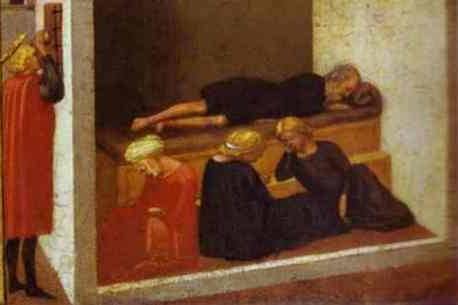
It is said that St. Nicholas, an orphan to whom was left much wealth, used some of his inheritance to save three women from a life of slavery to prostitution. Their father was poor, he had no money for a dowry, so the women would be unable to marry. If they could not marry, they would be sold. The legend goes that St. Nick tossed bags of gold through the window of the home until each woman was assured in marriage.

Sure, it is still a story of women being bought and sold, but in this case - a dowry for marriage places greater honor on the woman than being sold into sex slavery.

These days, women are still being bought and sold – pieces of property of little worth to society. It’s not just in other countries, it’s not just in bigger cities, it is happening in our own backyards.

As we celebrate St. Nicholas on his feast day, may we lift up prayers for victims of sexual abuse and human trafficking. May we explore ways we may have a hand in supporting organizations that work to alleviate sex slavery. And may we look at ways that we can speak worth and love and joy and peace into the lives of individuals we encounter every day. May we take the time to remind them they are wonderfully made in the image of our Creator, and no one has the right to do with them what they please.

(IMAGE: Masaccio - St. Nicholas Saving Three Sisters from Prostitution)