So, I knew going into the Anglican experience I wanted some prayer beads. I mean, Rebekah had some lovely ones she just received from Amanda at Love is a Seed, and Heather has me all prayer bead inspired since she’s been researching different variations. I’ve made a rosary for my Catholic father in the past, and some strings of remembrance prayer beads for my mom and aunts recently when my grandfather passed away.
My father’s piece was made with a patron saints medal of his I’ve had since I was a child, and I used green glass beads, Celtic knot spacers and a Celtic cross. I loved that medal, but never felt appropriate wearing it, seeing as the back was inscribed with “I am Catholic, in case of emergency notify a priest.” I was very pleased with how it turned out and thought about making a similar one for myself, but never did.
For my mother and aunts, I did a simple five bead strand with an acorn charm at the end. The beads were turquoise and the acorn a copper color, both elements that remind me of my grandfather. The acorn was a symbol that had come to mean much to them as they sat vigil bedside of their father, and I wanted that to signify that these beads were for them to hold and touch and pray in memory of him.
As soon as I decided I wanted a set of prayer beads for this liturgical year, it didn’t take me long to select my beads. What was harder was choosing the drop. Yes, I know a cross is the logical and traditional choice, but I have a quirky hang up about a “cross-centered” life. Besides, anyone who’s heard me teach will tell you I like post-resurrection Jesus best, but a loaf of bread just seemed to lack the pizazz needed for a focal piece. I needed something that would be meaningful to me, meaningful to how the story of scripture speaks to me, meaningful to my life in the Spirit.
A tree.
That’s it! It’s perfect! A yin-yang symbol of my Christian walk if there ever was one. Shadow and light. Doubt and faith. Hesitation and trust.
I actually wear a tree on my finger already, and I love to tell the story of how my philosophy professor once demanded I no longer ask questions about the tree in the garden – not that he didn’t want me to ask questions, he just wanted me to move on to something else. But that damn tree plagues me to this day (that’s a post for another day, probably along with further explanation of the cross-centered hullabaloo).
But the tree is not just something that raises questions for me (like, why DID Jesus curse that poor fig tree?), but also a beautiful symbol of life in the Spirit. The tree is a symbol of a rooted, abiding life – a life that bears the fruit of the Spirit, the same fruit that has nourished us, we offer to others. I think of family trees, and the genealogy of Jesus, the women and men whose stories come together to form the body of Christ, and the stories those of us grafted in bring. The trees will clap their hands with the joyful song of creation when redemption is fulfilled (I suspect they already are).
With my design plans set on the back burner to simmer, I slid into the back of St. Michael’s sanctuary on the first Sunday of Advent, and quickly spotted friends to sit with. I settled in, and gazed forward toward the altar. My eyes were immediately drawn behind the altar, beyond the center of the room, to the looming focal piece of the space – a large picture window, opening up the sanctuary to the beauty outside.
Trees.
And I realized, in that moment, that I will spend this journey not only experiencing the liturgical seasons within the sanctuary, but watching nature’s seasons change the trees just beyond. Every time I take the elements among this gathering of the body, it will be kneeling near trees that are journeying through their yearly process of renewal, of change, of death and burial and resurrection, of ordinary days before it all starts again.
The sermon (homily? I’ve got to get the terminology down…) focused on the life that exists in the transitions, the growth that occurs during those times we feel least in control of our lives. (Here’s a link to one of the stories that was shared: http://www.earthstewards.org/ESN-Trapeze.asp)
It was inspired by the Gospel reading of Luke 21:25-36:
“Look at the fig tree and all the trees; as soon as they sprout leaves you can see for yourselves and know that summer is already near. So also, when you see these things taking place, you know that the kingdom of God is near.”
The kingdom that was and is and is to come, the kingdom that Jesus proclaimed, is evident in the changing of the seasons: death and resurrection, suffering and reconciliation, uncertainty and wisdom.
Changing seasons can leave us feeling unsettled, like we can’t see the forest for the trees (see what I did there?). But when we can keep our focus on the big picture story, we know that changing seasons is part of nature, it’s part of the story of creation, it happens… and it happens again… and it happens again. Each time we transition through a cycle of life, we grow, we strengthen, we renew.
We experience resurrection, again and again and again – to new life, and new experiences, and new perspectives. Every time we’re convince we have God figured out, we see his plan for our lives clearly, change enters in, and the Creator asks us once again to open our hands, to open our hearts, and to release. We release our grip of control, and we raise our hands to hopeful trust.
And we wait.
We wait for new birth. We wait for new growth. We wait for the beauty of redemption.
We wait with trepidation, and the angels whisper “Do not fear.”
We wait with eager anticipation.
We wait with uncertainty.
We wait with hope.
We wait.
Showing posts with label advent. Show all posts
Showing posts with label advent. Show all posts
Monday, December 3, 2012

Saturday, December 1, 2012
~ On the Eve of Advent ~
(disclaimer: This is a long one. I ramble. You may want a cup of coffee…)
So, I think I’m going to be visiting my friends over at St. Michael’s Episcopal Church.
I’ve long held a curiosity for the Episcopal Church.
 My early background was a mixture of Catholicism and Agnosticism, with a healthy dose of neighborhood Vacation Bible School, but in my first year of high school I voluntarily converted to Christianity under the umbrella of the Southern Baptist Convention.
I didn’t know the term “evangelical,” but I was a good one. I wasn’t big on the persuasive nature of “witnessing,” but I was a quick learner and I could have a good religious discussion with the best of ‘em. I even knew which practices were biblical, and which Bible was biblical, too.
I remember my senior home room/physics teacher, aptly named Mr. Picard, giving me a good natured ribbing about the Bible I kept in my backpack. Something about the translation…? I mean, come on – it was NEW King James. What did he want me to use, The Living Bible? That wasn’t even the real words. There was a junior in an upper-level math class across the hall who would come over and hang around me (we assumed a crush) during home period, while I was busy sitting on the desktop, eating breakfast and lusting after a young Anderson Cooper on Channel One. I repeatedly asked Mr. Picard if he would make the guy leave (sure I thought he was adorable, but come on – he was a JUNIOR), but his answer was always the same: “Nah, you need a good Episcopalian boy…”
I didn’t really know what that meant, except that perhaps he thought this boy would turn me on to a liberal translation of scripture, and that was somehow a good thing in his eyes. But I knew the right path, and I would not be swayed.
As a sociology and philosophy major at a Southern Baptist University (this is that “right path” I was talking about), I was subjected to a scandalous viewing of the PBS documentary adaptation of Randall Balmer’s book Mine Eyes Have Seen the Glory: A Journey into the Evangelical Subculture in America. This is probably around the time I first began to pay attention to, and develop an understanding of, the term “evangelical.” It was also around the time I began to look at my own spiritual practices and beliefs through an external lense.
A lot of what Balmer examined and/or questioned resonated with me. What confused me, however, was his personal conversion. Balmer had left the evangelical subculture for the Episcopal Church. What the what? Why on earth would you want to pick a denomination with MORE rules? I mean, no one tells Baptist when to sit or stand… well, except the music minister, but that doesn’t really count… and no one makes us kneel. Raising our hands in worship is controversial enough, could you imagine if someone crossed themselves during prayer?! And they recite the same stuff – evangelicals pray their own words from the heart, as they feel led by the Spirit. Episcopalians just say stuff someone else has already written for them.
Sometime post-college, post-failed-grad-school-attempt (I never got around to writing that whole thesis thing) and while helping with a non-denominational church plant, I stumbled upon a book on the shelves of Barnes and Noble that seemed to call to me: Lauren Winner’s Girl Meets God. I had actually left my SBC Church and signed on the church plant after several frustrating years of experiencing “singles ministry.” Apparently, single Southern Baptists are only interested in two things: sex and marriage. Singles Sunday School classes are thus obligated to teach about two things: how to avoid sex and how to pursue marriage. I had become really interested in folks like Richard Foster and stuff like spiritual disciplines, and I voiced this repeatedly in leadership meetings, clearly not understanding what was best for me and my life. In the end, I grew weary, so when an opportunity to serve a new and growing congregation presented itself, I cautiously climbed aboard.
So I’m staring at the cover of this book, and I’m reading about a single girl and her spiritual practices and her intellectual pursuits and her love of God – it was a no-brainer purchase. I devoured Girl Meets God. I may have even had to replace my pen midway through from all the underlining and margin notes. Her journey may have had a different starting point, but I was really intrigued with where she ended up. For once the Episcopal Church took on a glimmer of beauty, awe and reverence I had not been exposed to in my other meager encounters. I began to appreciate the rhythm of the liturgy, the rootedness of the history, the sacredness of the ritual.
Slowly, as I matured, I began to recognize the increasing influence of Episcopalians in my life. I actually held an office, when I was in social work, on the third floor of a large, downtown Episcopal church. Two of the authors who both challenge and comfort me, practice the Episcopal faith, Phyllis Tickle (who has been an influence both in spiritual practices and, in more recent years, understanding my place in an emerging perspective of Christianity) and the late Madeleine L’Engle (whose writing, both fiction and non-fiction, has had such an impact on my life that I refer to her as my patron saint). I have also been blessed by Episcopalian friends and mentors, and spent more time in liturgical settings.
As I’ve found myself recently at a crossroads of congregational life, I’ve begun to take a more serious look at the Episcopal Church. Several years ago I left the church plant I had been a part of after some negative experiences with leadership there. I actually went through a period of being shell-shocked and found it difficult to attend anywhere, and was completely outside of church for about six months. I found a beautiful community, R Street Community Church (formerly Vineyard) that welcomed me, and my hesitations, and rooted myself there (though there seemed to be constant change around me as the community went through layers of transitions). It is R Street that prayed with me as I stepped into a roll of co-pastoring at Eikon Church, a community I had been connected with for some time. I knew going in that Eikon was in a stage of transition, and transition eventually led toward dissolution. As painful as walking through that process with a community was, I would not trade it for the world – there was a lot of learning, a lot of beauty, a lot of growth in that experience.
I placed no timeline on myself to plug in to another community, to make any decisions about my faith practice. Honestly, I figured it would be late March before I even began to think about what I might do. Though I love the R Street Community, I was feeling I might need to be somewhere where I can just kind of blend in for a bit… IF I ended up anywhere. But, as Advent has inched closer, I felt like I wanted to participate in the rhythm of the liturgy for the first season of the church year. And as I began to think about settling into one community for that season, I felt the pull to participate in the rhythm of the liturgy for a whole church year.
What if I let myself rest somewhere for a full cycle of the liturgical year, just listen and be for a bit, rather than lead and do?
Wouldn’t it make sense to do this somewhere steeped in the rhythm and the history? Wouldn’t it make sense to do this somewhere with familiar faces, with people who have already extended a welcome to come join them? Wouldn’t it make sense to do this with people who’ve already heard most of my questions and wacky ideas yet aren’t phased in the least by them? St. Michael’s is home to people who already speak into my life, who inspire me, who encourage me. I don’t have to make any decisions about becoming permanently rooted in this place, though the opportunity is certainly there. I could just "stand at the crossroads and look; ask for the ancient paths, ask where the good way is.” I could try and walk in it. I could find rest for my soul. At least for one cycle of seasons...
Wednesday, December 21, 2011
Advent Practice: Sobriety
I don’t want to be the girl who has to fill the silence;
The quiet scares me, ‘cause it screams the truth.
~ Pink, Sober
Simplicity and sobriety are hand-in-glove.
I, being a lover of fun and silliness, am using a less stale & serious definition of sober, choosing the following qualities: practicing moderation or self-restraint; refraining from excess or overindulgence; calm, quiet, composed; rational, realistic; free from exaggeration or speculation.
When you practice sobriety, it’s not that you never indulge, but rather that you exercise restraint – knowing your limits and the effects on others.
When you practice sobriety, it’s not that you are never boisterous, but you also do not fear silence and solitude, recognizing that quiet moments can feed the soul.
When you practice sobriety, it’s not that you never contemplate the what-ifs in life, but you don’t allow those prospects to anxiously control your present experience.
We all have our strengths, our preferences, but just as introverts need community, extroverts need solitude. It may take a bit more effort if it is not the environment that energizes you, but it is necessary to keep your spirit in balance.
Sobriety is recognizing when you are isolating and need to get around people, to practice community.
Sobriety is also recognizing when you are spending too much time in the company of others because you don’t want to have to sit with your thoughts – to listen to yourself, to listen to God.
Sobriety is recognizing when you are dragging your feet and it is time to act, to take a chance.
Sobriety is also recognizing when you are rushing around doing everything you can to keep from being still and abiding in the Spirit.
Sobriety is living in reality – reality of your situation, reality of your resources, reality of your life.
When we practice sobriety, we are freed to practice simplicity because we are not trying to bury reality under piles of material, emotional and spiritual stuff.
When we practice simplicity, we are freed to practice sobriety because we are throwing aside those things that keep us from seeing the path we’re on as it actually exists.
It’s a chicken-and-egg scenario, really.
So, as we inch closer toward the celebration of Christmas, as the winter solstice ushers us into the path that leans day by day toward light, in the waning twilight of Advent, may we take an honest look at our lives, a deep breath, and a heartfelt prayer, and may we step forward in the joy that each day is enough.
Monday, December 19, 2011
Advent Practice: Simplicity
Originally shared December 18th as part of Eikon Church’s Advent service:
A few weeks ago, I was snuggled up on the couch with my Mom watching a Hallmark Christmas movie starring Kristie Swanson, the ORIGINAL Buffy the Vampire Slayer. Swanson portrayed a single mother at the end of her rope, doing the best she could to provide for her children and keep some joy in the midst of their less-than-meager holiday season. Early in the movie she was in a rush to get to her job and get the children ready for their babysitter when one of the kids asked for something to eat – I can’t remember, maybe a pizza or something delectable. What I do remember is Swanson reaching into the cabinet, pulling something out, and exclaiming joyfully & wide-eyed: “We’ve got ramen!”
My mom and I lost it with laughter, tears rolling out of our eyes, breathless from the humor of it all. My stepdad stared at us in justified confusion. The children in the movie were not impressed. They groaned. Seriously? Ramen? Could life get any worse?
My mom and I laughed because we knew there was truly life after ramen. That there was even, hard as it was to be believed, life WITH ramen. Even ramen back when it was 12 for a dollar. Even ramen when it had to be split three ways because pay day was still a day away. Even ramen when the DOG didn’t want to eat ramen anymore.
Now, the reason I was watching this movie with my parents is that I am back living at home, diligently paying down my debts. Somewhere between ramen, student loans and financial independence, I lost track of what it looks like to live within my means.
Not that I was living extravagantly, mind you, but a month would get tight and I’d put some necessities on my credit card. Clothes wear out, and a modest shopping spree would go on my credit card. A well deserved vacation to visit a friend who lived far away? You guessed it, on my credit card. An unexpected vehicle expense, an unexpected move, an unexpected fill-in-the-blank… on the credit card.
As I was living in community, I didn’t quite notice how much I had become a slave to the credit cards and their debt interest until I was faced with the need to live on my own again, and I realized, while possible, it would not be very practical. So, here in my 30’s, I returned home to free myself from debt’s chains and learn once again what living in simplicity looks like.
Life is a journey, and we are often not at the wheel of control.
Mary certainly did not anticipate the sudden changes that came into her life, and the journey that laid ahead.
The more stuff we have cluttering up our lives, the less ready we are to keep moving along the journey – especially when change and chaos and transition come on the scene.
We are all at different places in our journeys, and we all have different amounts of stuff. Some of us are good at keeping the clutter at bay. Some of us are drowning in projects. Others of us can fit our possessions on our backs.
As Foster alluded to, the “crap” in our lives that we need to get rid of, is often internal.
Maybe we’re holding on to or storing up material stuff because it is filling an internal need we have not addressed.
But even if our internal struggles are not linked to external indulgence, they can still weigh us down.
What are you storing up?
What is weighing you down?
What is holding you back?
What do you need to release for your heart to be open to change, to transition, to the unexpected?
Is there hurt, bitterness or resentment for which you need to offer forgiveness?
I don’t ask that lightly, because I know it is a difficult process – but it is one I have walked through and would be willing to talk with any of you about. When we refuse to forgive – when we refuse to release the hold another person has on our life because of the pain they have caused us – we are the ones who carry the burden.
Are there unrealistic expectations you have for your life or someone else’s that you need to let go of?
Life has to be lived in the here and now, as it exists. That doesn’t mean we have to give up hopes or working toward dreams – but we can’t live in that place – in how life should be or how life was. Simplicity asks us to live life in the reality of now.
Are there anxious thoughts you’re storing up because they give you some level of control? Let them go, and be willing to take your journey one step at a time.
What are you storing up?
What is weighing you down?
What is holding you back?
What do you need to release for your heart to be open to change, to transition, to the unexpected?
----------
(click through to listen to Madison Greene's Departure)
A few weeks ago, I was snuggled up on the couch with my Mom watching a Hallmark Christmas movie starring Kristie Swanson, the ORIGINAL Buffy the Vampire Slayer. Swanson portrayed a single mother at the end of her rope, doing the best she could to provide for her children and keep some joy in the midst of their less-than-meager holiday season. Early in the movie she was in a rush to get to her job and get the children ready for their babysitter when one of the kids asked for something to eat – I can’t remember, maybe a pizza or something delectable. What I do remember is Swanson reaching into the cabinet, pulling something out, and exclaiming joyfully & wide-eyed: “We’ve got ramen!”
My mom and I lost it with laughter, tears rolling out of our eyes, breathless from the humor of it all. My stepdad stared at us in justified confusion. The children in the movie were not impressed. They groaned. Seriously? Ramen? Could life get any worse?
My mom and I laughed because we knew there was truly life after ramen. That there was even, hard as it was to be believed, life WITH ramen. Even ramen back when it was 12 for a dollar. Even ramen when it had to be split three ways because pay day was still a day away. Even ramen when the DOG didn’t want to eat ramen anymore.
Now, the reason I was watching this movie with my parents is that I am back living at home, diligently paying down my debts. Somewhere between ramen, student loans and financial independence, I lost track of what it looks like to live within my means.
Not that I was living extravagantly, mind you, but a month would get tight and I’d put some necessities on my credit card. Clothes wear out, and a modest shopping spree would go on my credit card. A well deserved vacation to visit a friend who lived far away? You guessed it, on my credit card. An unexpected vehicle expense, an unexpected move, an unexpected fill-in-the-blank… on the credit card.
As I was living in community, I didn’t quite notice how much I had become a slave to the credit cards and their debt interest until I was faced with the need to live on my own again, and I realized, while possible, it would not be very practical. So, here in my 30’s, I returned home to free myself from debt’s chains and learn once again what living in simplicity looks like.
Excerpt from Richard Foster’s Freedom of Simplicity:
Contemporary culture is plagued by the passion to possess. The unreasoned boast abounds that the good life is found in accumulation, that “more is better.” Indeed, we often accept this notion without question, with the result that the lust for affluence in contemporary society has become psychotic: it has completely lost touch with reality. Furthermore, the pace of the modern world accentuates our sense of being fractured and fragmented. We feel strained, hurried, breathless. The complexity of rushing to achieve and accumulate more and more frequently threatens to overwhelm us; it seems there is no escape from the rat race.
Christian simplicity frees us from this modern mania. It brings sanity to our compulsive extravagance, and peace to our frantic spirit. It liberates us from what William Penn called “cumber.” It allows us to see material things for what they are – goods to enhance life, not to oppress life. People once again become more important than possessions. Simplicity enables us to live lives of integrity in the face of the terrible realities of our global village.
----------
If simplicity were merely a matter of externals, things would be quite easy. We would then need only to formulate the system (no small trick to be sure) that defines the boundaries – Christian faithfulness would allow us to live in this income bracket but not that one, to purchase this house but not that one. We would have a clearly definable arrangement, even if it would need periodic adjustment to keep abreast of inflation. It would be clear who is in and who is out, who is faithful and who is not. Presto, a new pharisaism. Very fine, thank you.
Sometimes I genuinely wish it were that way. And I have no desire to speak disparagingly of the many groups who have developed such systems. In fact, I envy them at times, because the clarity of that approach has immense power to motivate and change behavior. But as we all know, its end result is bondage and death. The letter always kills; the Spirit alone gives life. Gospel simplicity gives freedom and liberation.
The outer expression of simplicity must flow from the inner resources. It is learning to walk in the Spirit that builds the life of purity, unity, and grace. There is an inwardness that is central to our task; without it all is lost. We delude ourselves, however if we think we can possess the inner reality of simplicity without its having a profound effect upon the way we live…
Life is a journey, and we are often not at the wheel of control.
Mary certainly did not anticipate the sudden changes that came into her life, and the journey that laid ahead.
The more stuff we have cluttering up our lives, the less ready we are to keep moving along the journey – especially when change and chaos and transition come on the scene.
Old blog post from Dave Bruno, 3 Consumer Justifications That End in Crap:
There are at least three excuses those of us with too much stuff use to justify our excess.
It would be wasteful to get rid of it. Uh, no. It was wasteful to get it in the first place. Now it’s just plain stupid to allow it to keep cluttering up your life. What’s wasteful is the mental and physical space that the stuff you don’t need and don’t even want is taking up. Stop wasting your life. Get rid of the crap.
I might need it someday. The moment this justification passes your lips you know it’s not true. Seriously. Here, try this experiment. Go into your garage, find that box you haven’t opened in a decade, dig inside of it, and pull out that graphing calculator. Now go stand in front of a mirror and, speaking out loud, convince yourself that you might need it someday. Liar, liar, pants on fire. Get rid of the crap.
It has sentimental value. Then why did you bury it in the closet? Besides, you don’t even like the uncle who gave it to you. The nostalgia you’re really missing out on are all the good times you could be having if you weren’t constantly reshuffling stuff inside your garage and closets. Get rid of the crap.
One thing is for sure. If you use these three justifications to keep loads of stuff, at the end of your days you are going to have, well, loads of stuff. Do you want the end to be filled with crap? Purge the things that are messing up your house and dominating your material and spiritual space. Then go live a joyful life that blesses others.
We are all at different places in our journeys, and we all have different amounts of stuff. Some of us are good at keeping the clutter at bay. Some of us are drowning in projects. Others of us can fit our possessions on our backs.
As Foster alluded to, the “crap” in our lives that we need to get rid of, is often internal.
Maybe we’re holding on to or storing up material stuff because it is filling an internal need we have not addressed.
But even if our internal struggles are not linked to external indulgence, they can still weigh us down.
What are you storing up?
What is weighing you down?
What is holding you back?
What do you need to release for your heart to be open to change, to transition, to the unexpected?
Is there hurt, bitterness or resentment for which you need to offer forgiveness?
I don’t ask that lightly, because I know it is a difficult process – but it is one I have walked through and would be willing to talk with any of you about. When we refuse to forgive – when we refuse to release the hold another person has on our life because of the pain they have caused us – we are the ones who carry the burden.
Are there unrealistic expectations you have for your life or someone else’s that you need to let go of?
Life has to be lived in the here and now, as it exists. That doesn’t mean we have to give up hopes or working toward dreams – but we can’t live in that place – in how life should be or how life was. Simplicity asks us to live life in the reality of now.
Are there anxious thoughts you’re storing up because they give you some level of control? Let them go, and be willing to take your journey one step at a time.
What are you storing up?
What is weighing you down?
What is holding you back?
What do you need to release for your heart to be open to change, to transition, to the unexpected?
----------
(click through to listen to Madison Greene's Departure)
Tuesday, December 6, 2011
Jolly Old St. Nick, patron saint of prostitutes
 The story of the destruction of Sodom and Gomorrah is one of the most disturbing in all of scripture.
In short, two angels come to the city of Sodom to warn a man named Lot that God is going to destroy the place, and that he and his family need to leave. Lot shows them hospitality & invites them into his home to stay the night. All the men of the city show up in a mob outside of Lot’s home and demand he send the visitors out so they can rape them.
Then, one of the most disturbing speeches in all of scripture:
“No, my friends. Don’t do this wicked thing. Look, I have two daughters who have never slept with a man. Let me bring them out to you, and you can do what you like with them. But don’t do anything to these men, for they have come under the protection of my roof.” (Genesis 19:7-8)
Look, angry mob, I have two virgin daughters – you can do what you like with them…
In my last blog post, I highlighted how women who may not have been up to “True Love Waits” sexual purity standards played a significant and integral role in the incarnation story.
In this post, I’m mourning how little value has been placed on women through history, and specifically their ownership of their bodies and their sexuality.
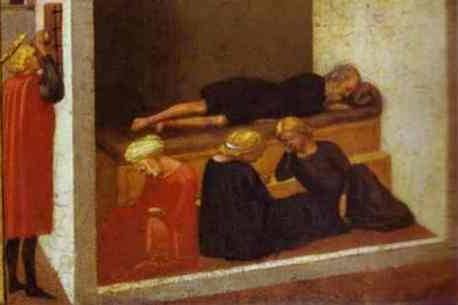
But the story of Saint Nicholas tells a vastly different tale.
It is said that St. Nicholas, an orphan to whom was left much wealth, used some of his inheritance to save three women from a life of slavery to prostitution. Their father was poor, he had no money for a dowry, so the women would be unable to marry. If they could not marry, they would be sold. The legend goes that St. Nick tossed bags of gold through the window of the home until each woman was assured in marriage.
Sure, it is still a story of women being bought and sold, but in this case - a dowry for marriage places greater honor on the woman than being sold into sex slavery.
These days, women are still being bought and sold – pieces of property of little worth to society. It’s not just in other countries, it’s not just in bigger cities, it is happening in our own backyards.
As we celebrate St. Nicholas on his feast day, may we lift up prayers for victims of sexual abuse and human trafficking. May we explore ways we may have a hand in supporting organizations that work to alleviate sex slavery. And may we look at ways that we can speak worth and love and joy and peace into the lives of individuals we encounter every day. May we take the time to remind them they are wonderfully made in the image of our Creator, and no one has the right to do with them what they please.
(IMAGE: Masaccio - St. Nicholas Saving Three Sisters from Prostitution)
Thursday, December 1, 2011
Lay Lady Lay
"Every woman learns to bleed from the womb, and we bleed to renew life every time it's cut down... It ain't no hassle, no, it ain't no mess, right now it's the only power I possess; These businessmen got the money, they got the instruments of death, but I can make life, I can make breath!"
~ Ani DiFranco, Blood in the Boardroom

~ Ani DiFranco, Blood in the Boardroom
This is the genealogy of Jesus the Messiah the son of David, the son of Abraham:
Abraham was the father of Isaac,
Isaac the father of Jacob,
Jacob the father of Judah and his brothers,
Judah the father of Perez and Zerah, whose mother was Tamar,
Perez the father of Hezron,
Hezron the father of Ram,
Ram the father of Amminadab,
Amminadab the father of Nahshon,
Nahshon the father of Salmon,
Salmon the father of Boaz, whose mother was Rahab,
Boaz the father of Obed, whose mother was Ruth,
Obed the father of Jesse,
and Jesse the father of King David.
David was the father of Solomon, whose mother had been Uriah’s wife,
Solomon the father of Rehoboam,
Rehoboam the father of Abijah,
Abijah the father of Asa,
Asa the father of Jehoshaphat,
Jehoshaphat the father of Jehoram,
Jehoram the father of Uzziah,
Uzziah the father of Jotham,
Jotham the father of Ahaz,
Ahaz the father of Hezekiah,
Hezekiah the father of Manasseh,
Manasseh the father of Amon,
Amon the father of Josiah,
and Josiah the father of Jeconiah and his brothers at the time of the exile to Babylon.
After the exile to Babylon:
Jeconiah was the father of Shealtiel,
Shealtiel the father of Zerubbabel,
Zerubbabel the father of Abihud,
Abihud the father of Eliakim,
Eliakim the father of Azor,
Azor the father of Zadok,
Zadok the father of Akim,
Akim the father of Elihud,
Elihud the father of Eleazar,
Eleazar the father of Matthan,
Matthan the father of Jacob,
and Jacob the father of Joseph, the husband of Mary, and Mary was the mother of Jesus who is called the Messiah.
Thus there were fourteen generations in all from Abraham to David, fourteen from David to the exile to Babylon, and fourteen from the exile to the Messiah.
(Matthew 1:1-17)
Wednesday, November 30, 2011
~ knitting up the fragments ~
"Cain murdered Abel, and blood cried out from the earth; the house fell on Job's children, and a voice was induced or provoked into speaking from a whirlwind; and Rachel mourned for her children; and King David for Absalom. The force behind the movement of time is a mourning that will not be comforted. That is why the first event is known to have been an expulsion, and the last is hoped to be a reconciliation and return."
from Marilynne Robinson's Housekeeping
from Marilynne Robinson's Housekeeping
Monday, November 28, 2011
Advent Practice: Listening

"As we move into Advent we are called to listen, something we seldom take time to do in this frenetic world of over-activity. But waiting for birth, waiting for death - these are listening times, when the normal distractions of life have lost their power to take us away from God's call to center in Christ."
~ Madeleine L'Engle, Redeeming All Brokenness
~ Madeleine L'Engle, Redeeming All Brokenness
Sunday, November 27, 2011
1st Sunday of Advent: Hope
 I remember my affliction and my wandering,
the bitterness and the gall.
I well remember them,
and my soul is downcast within me.
Yet this I call to mind
and therefore I have hope:
Because of the LORD’s great love we are not consumed,
for his compassions never fail.
They are new every morning;
great is your faithfulness.
I say to myself, “The LORD is my portion;
therefore I will wait for him.”
The LORD is good to those whose hope is in him,
to the one who seeks him;
it is good to wait quietly
for the salvation of the LORD.
(Lamentations 3:19-26)
Subscribe to:
Posts (Atom)