Showing posts with label reconciliation. Show all posts

Wednesday, November 13, 2013

Listen Up, Y'all!

If we are going to be in community with one another, whatever form that takes, we have to learn to listen to one another.

DSCN2824

If we are going to grow, to take deeply honest looks at our faults, to repent and turn in a healthy direction, we have to be willing to hear one another.

If I ever hope to become a wise elder, I have to first be wise enough to slow down, to listen, to hear, to process… these things precede all understanding.

Questions are healthy. Not having the answers is ok. Exploring the mystery together is growth. Listening together to how the spirit is moving, challenging, illuminating – this is an essential practice of the body of Christ.

When we fail to listen to those who feel their voices are being silenced, we dismiss their experience and receive their challenge as a something negative to be sneered at, rather than something valid and valuable from which we can grow.

“This is a common response to those of us who speak from the margins of evangelical Christianity about issues around gender, race, and sexuality, and it’s an effective one because it appeals to something most of us value deeply: Christian unity… far too often, the “stop-being-so-divisive” line is used by those in power to diffuse, or even silence, difficult conversations about why things might need to change… I don’t like being divisive. Believe me. But I don’t like being silenced either.”
~ Rachel Held Evans, “On Being ‘Divisive’…”

When we fail to listen to those who feel their voices are being silenced, we miss out on the beauty, honesty and healing that can come when we release our tight grip of control, and step out into the risky unknown of growth and change.

"To me, the marginalized are those who, for all kinds of different reasons, are on the border or edge of whatever groups or systems they are part of. They are not in the center where the power and resources flow, but instead are in the white blank space that lingers on each side of the center… So much beauty emerges from the margins, and I get to see it almost every day. Truth so pure that it is like gold. Beauty so glorious that it can’t be matched. Honesty so raw that it pierces souls. Healing so deep that it transforms the most hardened heart.”
~ Kathy Escobar, “Truth from the Margins”

Adam McHugh, who has an upcoming book on listening, recently tweeted, “We are, in large part, a result of the voices we choose to listen to. Pick good and diverse voices.” And also, “If the people with power in your community do not practice listening, odds are no one else will either.”

Who am I choosing to listen to?

How am I practicing listening?

Am I willing to learn from the voices that are speaking into my life?

Saturday, March 10, 2012

On the practice of forgiveness

Practice: to perform or do repeatedly in order to acquire skill or proficiency; repetition or exercise of an activity in order to achieve mastery and fluency.

"I think we need to not think of forgiveness as a kind of single, punctual act of will - I forgive, and it's over. I think we need to think of it as a practice, as living into something and walking in something, rather than simply doing it and then turning your head and going to do some other business."
~ Miroslav Volf


Thank you to Eric Guthrie for bringing this video to my attention.

Be sure to check out The Fetzer Institute funded film Forgiveness: A Time to Love & a Time to Hate to wrestle further with the practice of forgiveness.

Tuesday, December 6, 2011

Jolly Old St. Nick, patron saint of prostitutes

The story of the destruction of Sodom and Gomorrah is one of the most disturbing in all of scripture.

In short, two angels come to the city of Sodom to warn a man named Lot that God is going to destroy the place, and that he and his family need to leave. Lot shows them hospitality & invites them into his home to stay the night. All the men of the city show up in a mob outside of Lot’s home and demand he send the visitors out so they can rape them.

Then, one of the most disturbing speeches in all of scripture:

“No, my friends. Don’t do this wicked thing. Look, I have two daughters who have never slept with a man. Let me bring them out to you, and you can do what you like with them. But don’t do anything to these men, for they have come under the protection of my roof.” (Genesis 19:7-8)

Look, angry mob, I have two virgin daughters – you can do what you like with them…

In my last blog post, I highlighted how women who may not have been up to “True Love Waits” sexual purity standards played a significant and integral role in the incarnation story.

In this post, I’m mourning how little value has been placed on women through history, and specifically their ownership of their bodies and their sexuality.

But the story of Saint Nicholas tells a vastly different tale.

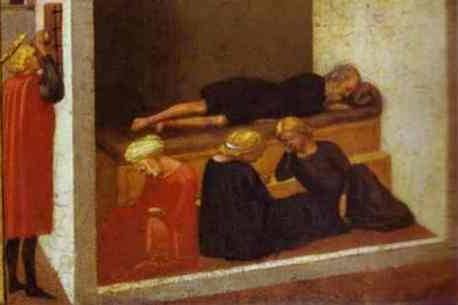
It is said that St. Nicholas, an orphan to whom was left much wealth, used some of his inheritance to save three women from a life of slavery to prostitution. Their father was poor, he had no money for a dowry, so the women would be unable to marry. If they could not marry, they would be sold. The legend goes that St. Nick tossed bags of gold through the window of the home until each woman was assured in marriage.

Sure, it is still a story of women being bought and sold, but in this case - a dowry for marriage places greater honor on the woman than being sold into sex slavery.

These days, women are still being bought and sold – pieces of property of little worth to society. It’s not just in other countries, it’s not just in bigger cities, it is happening in our own backyards.

As we celebrate St. Nicholas on his feast day, may we lift up prayers for victims of sexual abuse and human trafficking. May we explore ways we may have a hand in supporting organizations that work to alleviate sex slavery. And may we look at ways that we can speak worth and love and joy and peace into the lives of individuals we encounter every day. May we take the time to remind them they are wonderfully made in the image of our Creator, and no one has the right to do with them what they please.

(IMAGE: Masaccio - St. Nicholas Saving Three Sisters from Prostitution)

Thursday, December 1, 2011

Lay Lady Lay

"Every woman learns to bleed from the womb, and we bleed to renew life every time it's cut down... It ain't no hassle, no, it ain't no mess, right now it's the only power I possess; These businessmen got the money, they got the instruments of death, but I can make life, I can make breath!"
~ Ani DiFranco, Blood in the Boardroom


This is the genealogy of Jesus the Messiah the son of David, the son of Abraham:

Abraham was the father of Isaac,
Isaac the father of Jacob,
Jacob the father of Judah and his brothers,
Judah the father of Perez and Zerah, whose mother was Tamar,
Perez the father of Hezron,
Hezron the father of Ram,
Ram the father of Amminadab,
Amminadab the father of Nahshon,
Nahshon the father of Salmon,
Salmon the father of Boaz, whose mother was Rahab,
Boaz the father of Obed, whose mother was Ruth,
Obed the father of Jesse,
and Jesse the father of King David.

David was the father of Solomon, whose mother had been Uriah’s wife,
Solomon the father of Rehoboam,
Rehoboam the father of Abijah,
Abijah the father of Asa,
Asa the father of Jehoshaphat,
Jehoshaphat the father of Jehoram,
Jehoram the father of Uzziah,
Uzziah the father of Jotham,
Jotham the father of Ahaz,
Ahaz the father of Hezekiah,
Hezekiah the father of Manasseh,
Manasseh the father of Amon,
Amon the father of Josiah,
and Josiah the father of Jeconiah and his brothers at the time of the exile to Babylon.

After the exile to Babylon:
Jeconiah was the father of Shealtiel,
Shealtiel the father of Zerubbabel,
Zerubbabel the father of Abihud,
Abihud the father of Eliakim,
Eliakim the father of Azor,
Azor the father of Zadok,
Zadok the father of Akim,
Akim the father of Elihud,
Elihud the father of Eleazar,
Eleazar the father of Matthan,
Matthan the father of Jacob,
and Jacob the father of Joseph, the husband of Mary, and Mary was the mother of Jesus who is called the Messiah.

Thus there were fourteen generations in all from Abraham to David, fourteen from David to the exile to Babylon, and fourteen from the exile to the Messiah.

(Matthew 1:1-17)

Wednesday, November 30, 2011

~ knitting up the fragments ~

"Cain murdered Abel, and blood cried out from the earth; the house fell on Job's children, and a voice was induced or provoked into speaking from a whirlwind; and Rachel mourned for her children; and King David for Absalom. The force behind the movement of time is a mourning that will not be comforted. That is why the first event is known to have been an expulsion, and the last is hoped to be a reconciliation and return."

from Marilynne Robinson's Housekeeping

Thursday, March 24, 2011

Spring: part 4 ~ initiated


I wasn’t the one who did wrong.

I was hurt deeply, you see, so I deserved to feel this way.

And I planned to forgive them, but I didn’t know how. One and maybe I could have handled it. But not when each person’s injury was piled on top of the injuries that had come before. I’m not that strong.

I had books on my shelves that held pieces to the puzzle of forgiving, but I wasn’t quite ready to read them, certainly not to apply them. It wasn’t just the pain, it was the life changes I was forced to make because of each decision, each infliction, that was beyond my control.

But the Lord, he is a tricky thing.

I signed up for the prayer retreat because I love prayer. I love the conversation with my God. I love abiding in his presence, and listening and sharing. And I especially enjoy opportunities to get away to places of beauty and quiet, where I am free to give God my undivided attention.

Arriving at the retreat center, I was filled with joy. Entering the first session, I was filled with calm.

And then the invitation, to go around the room, to make introduction, and to answer the questions: Why are you here? What question will you take to God as you walk the labyrinth? What are you hoping to hear from him? What are you hoping to release?

Like a mother who has taken her child to the doctor on promise of ice cream (Oh, sure. There will be ice cream. But first, let’s go ahead and get these shots out of the way…), the element of surprise, no time to get anxious, just a quick pinch and then all will be well. And I’ll be here with you, holding your hand.

“It’s time,” God said.

“I know,” I replied.

And I did know, because the anxiousness was gone and his peace was present. Why was I there? What did I have to release? My firm grasp on a spirit of condemnation. I wanted to forgive, and I wanted to give up my need to control. I wanted to allow Christ to heal my hurt.

I really should have seen it coming. If I had brought my laptop, I could have looked back at the posts of the previous week and seen that God was leading me to this point. It’s not that I didn’t think I would get to a place of forgiveness, but I figured it would be down the road, after I had figured it all out and knew all the right words, and had sufficiently fortified myself against future attacks. In other words, I would forgive once I had regained control.

Saturday afternoon, after spending the morning reading scripture and resting, I wrote “loose” on my left wrist in thick black ink, for that was my intention. On each finger of my left hand, I inscribed the initial of someone whose debts I needed to forgive, whose actions I needed to release, whose sins I needed to loose. I approached the labyrinth, but I dared not enter. It wasn’t that I thought it was going to be a magical walk, but I knew it would be a powerful one. The path was designed so that I could simply follow, as I conversed with the creator of the universe. No big deal, right?

I circled once around the perimeter of the path, repeating “Whatever you bind on earth will be bound in heaven; whatever you loose on earth will be loosed in heaven.”

And again, repeating “Whosoever you forgive, their sins will be forgiven; whosoever you do not forgive, their sins will not be forgiven.”

A third time, “Forgive, as you have been forgiven.“

Then, because I still did not feel ready (and because I had made reference to the film The Labyrinth the previous day), I circled, repeating to the evil one “You. Have. No. Power. Over. Me.”

And to his fruit, I proclaimed (circling once for each):
“Bitterness has no power over me.”
“Anger has no power over me.”
“My wounds have no power over me.”
“Pride has no power over me.”

The last circle before entering the labyrinth walk was “God is greater than my heart, and he knows everything.”

He knows how I was hurt. He also knows what was going on in the hearts and lives of those I have been unable to forgive. He knows how he will redeem every person and every situation.

I stood at the entrance to the path, took a deep breath, said a prayer for peace and began my pilgrimage.

(to be continued tomorrow…)

Wednesday, March 16, 2011

Reconcilable Differences

on Binding and Loosing from John Howard Yoder's Body Politics:

Moral discernment and forgiveness condition and enable one another in complex ways. Admonition presupposes prior discernment; otherwise the criteria for admonition would not be common to both parties. Conversation with reconciling intent is the most powerful way for a community to discover when the rules they have been applying are inadequate, so that they may be modified. Asking whether there has really been an offense helps determine which differences need to be resolved by coming to unanimity by means of dialogue and forgiveness and which call for an agreement to differ. Having experienced forgiveness together enables a community to deliberate in an otherwise inacessible mode of mutual trust...

Taking seriously this apostolic witness would seem to put us at the mercy of a number of ecclesiastical scarecrows. It gives more authority to the church than does Rome, trusts more to the Holy Spirit than does Pentecostalism, has more respect for the individual than does liberal humanism, makes moral standards more binding than did Puritanism, and is more open to the new situation than was what some called "the new morality" a quarter-century ago. If practiced, it would radically restructure the life of churches...

...We have here a fundamental anthropological insight into the relationship of conflict and solidarity. To be human is to have differences; to be human wholesomely is to process those differences, not by building up conflicting power claims but by reconciling dialogue. Conflict is socially useful; it forces us to attend to new data from new perspectives. It is useful in interpersonal process; by processing conflict, one learns skills, awareness, trust, and hope. Conflict is useful in intrapersonal dynamics, protecting our concern about guilt and acceptance from being directed inwardly only on our own feelings. The therapy for guilt is forgiveness; the source of self-esteem is another person who takes seriously my restoration to community.

The Christian community has thereby been endowed with the wherewithal for ongoing moral discernment in the face of questions which could not conceivably have been answered substantially ahead of time. Just as a wisely written constitution for an institution or government provides procedures for amendment and for decision making rather than immutable prescriptions, so the Christian community is equipped not with a code but with decision-making potential.